Saturday, August 16, 2014

Can we have the sharp sign back now?


If you routinely hashtag, you may fully disagree with this post.  I understand, and that is your choice. Still, let me explain why I don't use them on social media (as well as the Facebook "like" button or Twitter "@," but those are different posts).

Coherence:

You are reading this sentence in your normal voice.  #nowyourereadingitinalowmonotoneandfastvoice.  

See how that broke up the flow?  When a person reads something internally and it's peppered with hashtags, it is less coherent and harder to follow.  In writing, I try to write as if I was speaking out loud - then I am more well-rehearsed in coherent conversation when I do.  Keep this change of tone in mind as you read the rest.

Credibility:  I have a few friends well-versed in communication and promotion - they know how to utilize social media, and they can get away with #hashtagsoneverything #andstill #itmakessense.  For the other 90% of the symbol's manipulators, it juices the serious tone out of whatever you just said.

My skills in marketing and interpersonal relations have been honed by twenty years of service experience in a developing company.  I strive to be resourceful and professional in each task.  #hireme

Practicality:  Originally, the hashtag was invented for Twitter usage to group posts by topic - then, someone could search a "trending" news item and see them more clearly organized.  It quickly lost this function, however, and people started thinking of it as a dress-up function for their updates.

This is what I have to say, and because I'm one of these people, I'm #hashtaggingendsofeverysentence.  
So then Facebook users started doing it.  Sorry guys, it doesn't work.  Oh wait.  They MADE it work.  In most cases, though, it ends up being word clutter, and harder to see the real meaning.  #excessive #redundant  #superfluous

Literary Technique:  Some might aver that hashtags are their own literary form of writing - you express something and add a few more ideas at the end.  #context  #justforkicks.  Still, social media followers are reading this in their heads over and over, and then it turns into speech in real life - ergo the song "#SELFIE."

Could we just show culture what it means to converse meaningfully?  If you have a thought, presenting it in a way that conveys a direct message instead of #together #adding #stringing #ideas #order #in #random.

Happy 60th Birthday to my dad!  I thank God every day for your example of sacrifice and love in my life.  Your appreciation of books, patience with my parking skills, and Scrabble wits inspire me to learn.  Enjoy the cake!

Happy birthday, Dad!  #60 #example #Scrabble #literary #hetakesthecake


Disambiguation:  Before the hashtag, the symbol indicated other extremely common things, such as pounds, numbers, or to the entire world of music, SHARPS.  Now, children learning to play tic-tac-toe or music students playing C# Major pieces in an atonal key signature are quite confused.  Well, we were there first.

Finally, there's something I need to get off my chest.

#isasharp #7thinharmonicminor #6thinmelodic #impliescontinuosecondarydominant #musicaficta

Whew.  You know, maybe the musicians need to start a trending discussion using flat symbols.  Then everything would be natural again.


Tuesday, August 5, 2014

The church that wouldn't sing

"I have no pleasure in any man who despises music.  It is no invention of ours; it is the gift of God." - Martin Luther

Dear Pastor:

About a month ago, two of my friends and I visited your church once while in town.  Looking for a congregation of my fellowship at which to hear God's Word and worship, I did research and found your parish, and it appeared to be a promising, confessional Lutheran assembly.

Settling into our pew near the back of the ornate, historical sanctuary and locating hymnals, we were instructed by the HD flatscreen to join in hymn 593.  We did so.  Glancing about the room, I was shocked - not one member of the 20 or so present sang along.  Perhaps about half of them had hymnals open and were leaning over to read the words, yet no lip movement.  The others, all of whom were seated towards the west end of the church, faced straight ahead.

My friends and I continued along, leading the hymn in equal volume to the organ, splitting into parts, adding a descant, and so on as we were used to doing.  The sermon ironically concentrated on enthusiastic outreach to the community, and consisted of primarily third function of the law - not misfitting within context.  To close the service, you and your vicar planned to supplement the message on evangelism with a video on abovementioned flatscreen, but after a solid five-plus minutes of attempts, the presentation was adjourned.

Following the benediction, a woman in front of me, who had been silent for the whole hour next to her restless teenage son, turned around and complimented me on my singing voice, interested in knowing if we were musically trained.  I explained to her that although I am an organ major and have had limited vocal instruction, I enjoy singing hymns and think it is an important part of the Divine Service.  Upon shaking your hand, Pastor, I thanked you for chanting the cantor's part in the psalm.  You apologized for your weak singing voice, but I tried to encourage you for setting a good example for your church.

What we saw and didn't hear was disappointing, not because we were graduate music majors, but because we were Christians who believe that hymnody and liturgy is a central part of worship.  It has nothing to do with how "well" people can sing.  If anyone thought he or she could please God or be a better Christian by the quality of the sacrifice - if that is how congregational song is viewed - there is no way even I could impress God.  Yes, to some extent worship concerns rendering the Lord His due honor, as expressed in Scripture, but even that is for our edification as well. A church musician named Louis G. Nuechterlein wrote, "The music of the congregation derives from the triangular shape of Christian worship...God Himself communicates with His people in Law and Gospel; Christians communicate with God in prayer, praise, and thanks; Christians teach and admonish one another (Colossians 3:16)."

The Lord does not need those He has created to tell Him His attributes in order to possess them. By singing the Word in church, the Holy Spirit brings the salvation truth to the believer personally, and he or she actively confesses the good confession (1 Timothy 6:12) in a way that increases memory of those doctrines like no other method.  Additionally, though aside from experience it is difficult to explain, singing hymns in church connects one to the believers of the past as well as others living elsewhere, reassuring the believer that "no temptation has overtaken you except such as is common to man" (1 Corinthians 10:13).

I fear that if this is a habit and not an isolated circumstance, it is a symptom of a larger problem.  Do they feel self-conscious compared to the other worshippers (who in turn are also not singing)?  Do they lack interest in Scripture in metrical form, or any form for that matter?  Does the use of a screen possibly confuse some of the older members?  Might there be a way you could call upon some local students of the fellowship to assist in leading music from the pew?

Here is an excellent description from Carl Halter and Carl Schalk's A Handbook of Church Music:

The music of the congregation is not that which is sung by the clergy or choir in the congregation's behalf, with the congregation as an attentive and appreciative audience.  Nor is it music scheduled for all the people to sing, but in which only a faithful few participate while the majority stand with hymnals open but with mouths shut.  The music of the congregation in that in which all those gathered for worship take an active part, regardless of ability or vocal skill.  Even those very few who cannot carry a tune join unabashedly in the singing, using their limited vocal resources in the praise of God (136).

It is my sincere prayer that your parishioners will learn that song is not something others do for them, but their own treasure to have and enrich in the one true faith.

Sincerely,

A concerned Christian and teacher of the Gospel in song

Tuesday, July 29, 2014

Schütz happens.

GUYS.  Then there is the one Heinrich Schütz cantata where the scoring IS THE TEXT-PAINTING ITSELF.

What?

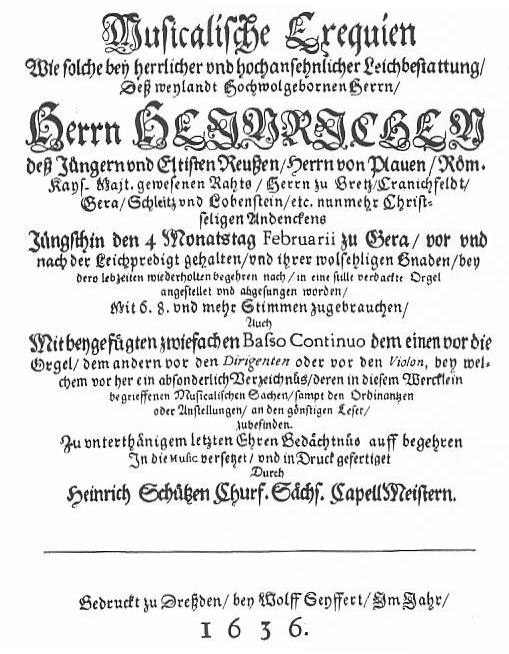
For the funeral of Count Heinrch Posthumous (yes, I'm not kidding) Reuss, Schütz composed a Lutheran type of funeral mass, the Musikalische Exequien, completely unique in form.
The Kreuzkirche in Dresden where Schütz worked.


The first movement is the Lutheran "missa brevis," the Kyrie and Gloria for six voices and/or instruments - Schutz and other of the time believed in an early sort of Gebrauchsmusik in which they could customize it depending on the forces available.  Only single parts of this score are extant, so there may have been any number of combinations in voicing or instruments.  Here, biblical texts showing the Christian's beliefs concerning death and resurrection are accentuated with chorale verses in a straightforward cantionale-homophonic texture.  As if to comfort the grieving listener, key concept in each verse are painted very obviously or repeated motivically.  For example, the Romans 14:8 mini-aria preceding the Kyrie II describes "living" and "dying" in Christ with appropriately perky or languid tempi.  "Our true life is in heaven," a duet sings, where the believer's likeness is transfigured unto Christ's, illustrated by a similar ornament transforming the word.  "The souls of the righteous are in God's hand" by the full ensembles is surrounded by the sopranos echoing "But they are at peace" (Ecclesiastes 3:1-3), wrapping the hearts of the faithful in rest.


Secondly, Psalm 73:25-26, the sermon text, becomes a double-choir motet.  The rich scoring does in no way obligate it to be overpowering, but instead it creates a quietly intense, prayerful tone.  "Whom have I in heaven but You? And there is none upon earth that I desire besides You. My flesh and my heart fail; but God is the strength of my heart and my portion forever."  Listen carefully.  Is there a familiar chorale melody hidden in there?  Hint:  it seems to be a common occurrence.  At the end, "my comfort" and "my part" scattered between the sides of the room provide a exclamation point, leaving the ear with "Jesus only."
Title page of the first print.


At last, the tenor intones the well-known Nunc Dimittis:  "Lord, now You let Your servant..." and the SATB choir finishes.  With written directions to be at a removed location from the main ensemble, two sopranos (Seraphim I and II) and a bass (the Departed Blessed Soul) sing "Blessed is the man who dies in the Lord" (Revelation 14:13) sailing ethereally over the congregation below.  The way in which Schütz arranges the two texts also seem to bring out other Scriptural comforts - the soloists' "They have rest after all their works, and their works follow them" is interrupted by the tutti "for all people," implying that the peace of the Church Triumphant lies in the same salvation believers grasp by faith on earth.  "Death" is the last word by the trio, while the choir finishes singing yet of God's glory.  

Enjoy!

Translation: http://www.spectrumsingers.org/archives/1997-98/mar98_words.html (This ensemble's notes are also helpful.)
Score:  http://imslp.org/wiki/Musikalische_Exequien,_Op.7_(Sch%C3%BCtz,_Heinrich)
Recording:  https://www.youtube.com/watch?v=_Gd1DqDUC2U

.

Sunday, July 20, 2014

Cheesecake girl.

How I often feel, living my single-girl musician graduate student life:  


Day 363:  the terror continues. Also, made another cheesecake! ...Very nearly.  Oh, and it’s my mum’s birthday. Happy birthday, Mum. I did make you a cheesecake, but it was too beautiful to live.


When one gets bored in her own little world, baking happens.  This gluten-free and vegan recipe happened quite well.

Chocolate Peanut-Butter "Cheesecake"

Crust:  
2 c. almond flour
1/4 c. unsweetened cocoa powder
1/4 c. coconut oil
2 tbsp. organic maple syrup
1 tsp. vanilla
Coffee as needed

Filling:
10 fresh figs, chopped
2/3 c. unsweetened cocoa powder
1 14-oz. package extra-firm tofu, drained
1/4 c. peanut butter
1/4 c. agave syrup
Dash of cinnamon

Blend all crust ingredients in food processor.  Press into 9-inch springform pan and chill in refrigerator.  Blend all filling ingredients until smooth.  Spread on top of crust and chill until firm.

Remember:  the cheesecake isn't the cheesecake - the cheesecake is the recipe!

Saturday, June 28, 2014

The crash-course guide to Bach motets

Motets, as Bach defines them, are a slightly different genre than used before.

 The “cantata,” a new genre, came to mean a multimovement work typically beginning with chorus, alternating arias and recit, and concluding with a chorale.
 Motets are essentially cantatas consisting of all choral movements
 No librettist, aside from the chorales, is credited – Bach selected the texts
 Written approximately between 1723-29 at least some and possibly all for funerals
Things for which to listen in Bach:
 Laughter/dancing
 Sighing/weeping
 Wandering/fleeing
 Cross
 Trinity
 Rhythms and meters signifying biblical numbers
 Soloists and instrumentalists themselves text-painting
 Doctrine of affections

Singet dem Herrn ein neues Lied (BWV 225)
Sing to the Lord a new song
1. Singet dem Herrn (Psalm 149:1-3)
2. “Nun lob, mein Seel, den Herren” v. 3
3. Lobet den Herrn (Psalm 150:2-6)

Two choirs toss back shouts of “Singet!” and playful figures in 3/8 to illustrate the joy of the Christian, additionally text-painting on the words “Harfen,” “Pauken,” and “Reichen,” making use of the “laughing” style. The second movement, an aria alternating with a chorale movement, blends the two with supplementary texts and similar melodic shapes. Lastly, “Lobet den Herrn” returns to the effervescent style of the first movement, rolling back and forth in 3/8 between choirs until combining all to sing “Praise the Lord!” at the end.

Der Geist hilft unser Schwachheit auf (BWV 226) The Spirit helps in our weakness
1. Der Geist hilft unser Schwachheit auf (Romans 8:26)
2. Der aber die Herzen forchet (Romans 8:27)
3. “Komm, Heiliger Geist” v. 3

Composed in a rush in October of 1729, this cheerful motet was sung for a funeral for the rector Johann Ernesti, or adapted from a now-lost cantata. Rocketing off in the bright key of B-flat Major, the laughing groups of spiritlike 16th-note figures surround the listener in polychoral comfort that “The Spirit helps in our weakness.” Bach must have written the verse from memory, for the word “selbst” seems to have an extra syllable. Secondly, the words “He who examines hearts…” are set to a canon, hinting at the fact that He is measuring something according to the Law. Finishing this lively fugue is the third verse of “Come, Holy Ghost, God and Lord,” praying for the Comforter to come and strengthen the hearts of all believers.

Jesu, meine Freude (BWV 227)
Jesus, my joy
1. “Jesu, meine Freude” v. 1, 4
2. Es ist nun nichts Verdammliches (Romans 8:1)
3. “Jesu, meine Freude” v. 2
4. Denn das Gesetz (Romans 8:3)
5. “Jesu, meine Freude” v. 3
6. Ihr aber seid nicht fleischlich (Romans 8:9)
7. “Jesu, meine Freude” v. 4
8. So aber Christus in euch ist (Romans 8:10)
9. “Jesu, meine Freude” v. 5
10. So nun der Geist (Romans 8:11)
11. “Jesu, meine Freude” v. 5

This simple pairing of verses from Paul Gerhardt’s hymn with passages of Romans 8 shows Bach’s theological mastery as well as text-painting skills. Each verse of the chorale is set to fit the text: “Now there is nothing, nothing” is set quite emphaticallythe third verse, on the word “trotz,” meaning “defiance,” is spit out with anger, hinting at the cantus firmus in the shape of the melody. “Tobe,” the word for rage, is painted with an aggressive run in the tenor and bass. “You are not in the flesh, but in the spirit,” has a very long melisma on the latter. The fifth verse “Good night,” sighs as the walking continuo marches away from the world’s temptations. Romans 8:10 then adds how the believer will be raised again from the
dead, with the “spirit” figure at the close coming to rest. Lastly, the final verse looks to Jesus’ entrance as the Master of joy in a glorious four-part setting identical to the first.

Furchte dich nicht (BWV 228)
Do not fear
1. Furchte dich nicht (Isaiah 41:10)
2. Furchte dich nicht, denn ich habe (Isaiah 43:1)
3. “Wann ich gramen” v. 4 and 5

Some consider this to be the most difficult of Bach’s motets. In the opening figure, the choir is scattered everywhere, almost as if they doubt the plea “Do not fear.” “I will strengthen you” is the next motif, supported by fully-diminished seventh chords. The extent of repetition emphasizes how much the listener needs it.

In the third movement, a descending chromatic subject penetrates all voices parts underneath the soprano cantus firmus. To close, all exclaim “Do not fear” several times, ending in homophonic motion: “you are Mine!”

Komm, Jesu, komm (BWV 229)
Come, Jesus, come
1. Komm, Jesu, komm
2. Drum schliess ich mich in deine Hande

With a cry of urgency, each side of the choir calls out “Come!” with a slow pace to suggest “my body is weary.” Painting “waning strength,” they start out the next phrase with vigor but then die away in tempo. Thinking about peace, they cadence at a major chord before going on to the “sour path,” then “yielding” in rest to Jesus at the end. This motet’s following aria prays that the Lord will come quickly, singing the world a farewell, and commiting quietly to Jesus at the end.

Lobet den Herrn alle Heiden (BWV 230) Praise the Lord, all ye nations
1. Lobet den Herrn alle Heiden (Psalm 117)

The opening triadic shape of the text, Psalm 117 exudes a festive, confident air, imitating trumpets and timpani with the layering and melismas of voices. Describing God’s “grace and truth,” the style slows and becomes homophonic, regaining speed and polyphonic texture to paint His rule for eternity, and a joyous Alleluia in a waltz-like triple meter.

Works Cited:
Emmanuel Bach Choir. “Motets and Liturgical Works Notes and Translations.” Emmanuel Bach Choir. Web accessed 26 June 2014. http://emmanuelmusic.org/ notes_translations/nt_notes_transl_motet.htm#pab1_7
Geck, Martin. Johann Sebastian Bach: Life and Work. Orlando: Harcourt Publishing, 2000.
Shrock, Dennis. Choral Repertoire. London: Oxford University Press, 2009.
Stapert, Calvin R. My Only Comfort: Death, Deliverance, and Discipleship in the Music of Bach. Grand Rapids, MI: Eerdmans Publishing Company, 2000.

Saturday, June 21, 2014

Adventures in Grad School, Part 2

A test, hymnal review, article review, many Finale transcriptions, four organ lessons, a choral hymn setting, and about 70 hours of class later, I am done with grad school.  The first half of the session, and over half of my whole MCM degree.

The Kretzmann post feels like forever ago.

Anyhow, since then, I promise that I have learned LOTS, including actual coursework.  One of them is that I say the word "actual" way too much - oops.

Last Sunday, Trinity Sunday, I attended my first-ever hymn festival for the dedication of this organ:
My organ instructor led the special program, several choirs sang, the parish handbell choir rang, and the pastor read the three articles of the Creed from Luther's Small Catechism while we joined in on hymns describing the explanations to each.  Fun!  More ideas for MY upcoming senior service/project, whenever that is.

To reward ourselves for doing so well in an unconditioned church on an 80-degree afternoon, my friends and I wandered over to our favorite frozen custard joint, where I tried a banana split for the first time.

For one of our projects, I got to explore the rare-book room here at school, and obviously did make it out of there.  Just barely.  Gingerly, I perused the tiny German hymnals, numerous English psalm books, and other token publications of the old Synodical Conference with columns so tight and bindings so fragile I was afraid to drop anything.  There, in the crisp air, I cradled several of them in white-gloved hands, smiling as I traced the names written inside.  Each one belonged to someone like me.  For the first half of my project, I selected the English Chorale Book for England, and carefully paged through, taking down its organizational characteristics.

Another perk about school?  Running by a lake every morning.  :)  I've discovered it's hardly possible for myself to listen to anything but the grandest music with this view.
Perfect.  It's also always cool early in the morning here, and not many people can roll out of bed and come this far to be right on the shoreline, so awesome for the students here.

For lessons, I get to work with one of these:
Yes, that is a Zimbelstern.  Apparently, in some Lutheran synods, this stop of whirling bells is Pavlovian for "Please rise and sing the Doxology."  Currently, I'm working on a Herman Schroeder prelude, Brahms' "Schmucke dich," Buxtehude Prelude/Fugue/Chaconne BuxWV 137, Joseph Jongen's "Choral," and Bach Prelude/Fugue in c minor BWV 549.

Today, I'm getting together and exploring the area with some friends who live about an hour away - so excited!  The end of classes are in sight.  Still, I'm realizing in all of this that I'm really not cut out to live by myself.  Doing serious coursework like this, it's honestly very difficult for me to get back to my suite and have no one with whom to recall the day's events.  That's why I blog.  Hopefully I can have a person someday to share morning coffee and Gerhard loci and silliness and awesome music...

You can tell where my mind is.  Happy Saturday.  Study hard and play hard, and God's blessings on all of it.

Tuesday, June 10, 2014

The Kretzmann cantatas

Did you know that Paul Kretzmann (author of the venerable Popular Commentaries) also wrote cantata libretti?  You probably didn't.  That's because from my library catalogue-digging, only two locations have scores available to borrow.  However, one of them happens to be where I go to school.  Guess what I did this afternoon.


I checked both of them out!  Kretzmann actually founded the church where my dad was a pastor, and I was baptized and a member there until I was four years old, so seeing these is like a letter from an ages-past friend.  

Both of them are in delicate shape, rebound, and taped.  I tried to play through them on a practice-room piano, but had to gently place my cell phone over the bindings the whole time to keep them from closing or tipping.  

Stylistically, I don't want to label them "schmaltzy," but the Romantic harmonies of the piano accompaniment, rich with secondary V7s and diminished viis, almost render it over to the concert nature rather than a special festival service.  The melody lines are rather complicated and at times chromatic.  Nonetheless, the words are great and biblical, just like his hymn translating and hymnwriting.  

Examples of text (all copyright by Concordia Publishing House):

Our King Victorious,Part III, 9. Chorus with Children's Chorus
Let us with joyful tone the Savior's praises sing,
Messiah on His heavenly throne devoutly worshipping
Who deigned in flesh to shade His glorious deity,
Himself of no repute made us lost ones to set free, 
Exult we on that day 
When Jesus rose on high
And opened wide the living way
Deliverance is nigh
Let stars and earth and heav'n rejoice
And all angelic choirs on high 
Upraise their glorifying voice 
To praise the Trinity.
Amen!  Hallelujah!


Unto Us, 24. Soprano
Bright was the guiding star that led with mild benignant say,
The Gentiles to the lowly shed where the Redeemer lay,
They brought Him gold, as King that reigns forever, 
They offered incense, as to a mighty God, 
And myrrh withal, since death their Lord would sever,
From those He loved, and on whose foes He trod.  

In addition, he also at least wrote the words for Der 46th Psalm (1921), Cantate! A Song Service (1924), Liturgical Service for Rally Day (1927), He Lives!  A Childrens' Vesper Service for Easter Day (1929), In Dulci Jubilo and Soli Deo Gloria (no dates) (see http://webapp1.dlib.indiana.edu/inauthors/view?).  

Here also is an interesting link to his hymn texts that have made it into lesser-known hymnals:  http://www.hymnary.org/person/Kretzmann_PE3

Happy digging!