Friday, May 16, 2014

My second-highest possession

Today, May 16, 2014, I "should have" graduated.  God had other ideas.  I'm still in school, in fact two different ones, and will graduate in two more years.  What's wrong with me?  


As I watch the class I came in with as an undergrad walk and flip tassels today, I thank God for my second-highest gift besides saving faith in His promise:  my education.  The Lord has somehow put the right people in my life when I could grow from them the most, whether professors or other students, and their "Yeses" and "Nos" have reshaped my future.  

The ability to go to an academic institution and earn high grades is a beautiful blessing from God, for which the graduate should give hearty thanks.  Not everyone can or has the will to do so, and it is certainly a way to publicly glorify Him.  I look at life as kind of a game:  how much can I further my understanding by the end of the day, to more and more enhance my ministry as a Christian in two "kingdoms"?  Some view college as a contest to see how much nothing they can do in the space of four years, but really, how much "something" can you cram into every day?  

Often, learning is not what you expect - it may come in a conversation in the car, an emergency, encountering a person you never really became acquainted with before, trying a new skill in your field, reading, or solving a problem with a group.  Every single day, our hours are composed of these types of things, one after another.  Stepping back and checking out what I do in a day, the Lord has seen to it that these "classes" give me a full schedule.  It's just up to the student to run around with the intellectual "butterfly net" and grab all of the knowledge that exists to be caught.  

To my teachers in whatever form:  thank you for putting up with all of my hand-raising, questions, and tangents, plus reading my logical soups called research papers and clapping at my recitals.  I thank the Giver of all wisdom for placing you in my life for edification to His praise, and hope that you may be enriched "beyond a lifetime."

To all student:  keep taking the classes of Christian life, no matter what kind of student you are.  Your gracious God has laid wide the privilege and signed all of the application sheets for it in His precious words of salvation.  

"In Christ are hidden all the treasures of wisdom and knowledge." Colossians 2:3

"God gives us richly all things to enjoy."  1 Timothy 6:17


All our knowledge, sense and sightLie in deepest darkness shroudedTill Your Spirit breaks our nightWith the beams of truth unclouded;You alone to God canst win us;You must work all good within us.
Glorious Lord, Yourself impart,Light of Light, from God proceeding;Open now our ears and heart,Help us by Your Spirit’s pleading.Hear the cry Your people raises; Hear and bless our prayers and praises.
- Tobias Clausnitzer, "Blessed Jesus, At Your Word"

Sunday, May 4, 2014

All Keyed Up program notes

I'm super weird, because I think of program notes as an opportunity, not an assignment.  My two biggest interests (music and writing) intersect, and it usually turns into something subtly persuasive, why art music is still cool.

Case in point:  I gave a collaborative-piano recital this afternoon with a soprano, a mezzo, a flutist (ahem, that is what they like to be called) and a second pianist.  Knowing me, I got the coffee theme in there somehow.

I additionally attempted to integrate coffee puns into every paragraph of the notes, but I'm sure that would have gotten me grounded (aha! ha!).  With or without, enjoy. 

Program Notes

Frédéric Chopin may have not been able to decide between composing a nocturne, an etude, and a waltz, so he blended all of them together into one of the first programmatic instrumental pieces:  the ballade.  This genre sets forth a story in several parts, each flowing seamlessly into the next.  Musicologists wonder if the Ballade No. 3 describes a disastrous Majorca vacation with his lover –uncomfortable carriage rides and loud thunderstorms kept interrupting the romantic moments.  Considering the style reminiscent of Viennese waltz, it also seems to depict a scene from a 19th-century ballroom.  The listener will have to guess what the performer’s personal narrative is.

Christoph Willibald Gluck’s opera Paride ed Elena (Paris and Helen) chronicles the mythological opening to the Iliad:  Paris, winner of the Olympian contests, has chosen love, and falls in love with Helen of Troy.  Baroque operas such as these are rarely performed in entirety (the form dramatically and musically matured later), but vocalists often single out arias for concert performance.  Tenors often choose O del mio dolce ardor, a first-act declaration of love, but it may also be performed by a female soprano, as is done here.

Ernest Chausson’s music lands stylistically between the Romanticism of his teachers Cesar Franck and Jules Massenet and the beginnings of Impressionism.  A writer and painter himself, Chausson gave his art songs a florid and elegant simplicity foreshadowing that of Debussy’s later piano works.  In this selection from 7 Melodies, the composer lushly sets a poem by Leconte de Lisle about a lover comparing a hummingbird at the flowers to his lover’s kiss. 

Imagine stopping by the city’s favorite coffeeshop after church to find Johann Sebastian Bach directing a cantata!  After Sunday morning services wrapped up, Bach found time for his other pursuits:  a side stint at Café Zimmermann, Leipzig’s largest and best niche of its kind.  Instituted by Georg Philip Telemann, its resident collegium musicum drew its support solely from the café’s sales, and often premiered Bach’s new secular works, including the comical “Coffee Cantata.”  Essentially a miniature opera, it presents an argument between a father who wants his daughter Lieschen to give up java for a husband, and the daughter who ignores his pleas.  In the end, she pretends to agree with him, but secretly spreads the word that any potential suitor must allow her to make coffee any time she pleases.  Ei! Wie schmeckt der Kaffee süße is her “love ballad.”

Clearly undistracted by its cultural scene, Wolfgang Amadeus Mozart experienced one of his most productive bursts of inspiration in Vienna from 1784-86, finishing the last 12 of his 27 piano concerti.  Of this set, No. 25 (K. 503) is one of the lesser-performed, but nonetheless has a authoritative and distinguished personality – the first movement’s themes may have inspired Beethoven’s Piano Concerto No. 5 and Symphony No. 5, and the second motif hints at France’s national anthem.  The composer supplied no cadenza for this piece, so the soloist simply takes the second-inversion chord and runs with it until cuing the orchestra - or second pianist.

Once again, we explore the fine line between French music and Impressionism in Poulenc’s Flute Sonata.  As one of “Les Six,” a sextet of composers seeking a national musical voice for France, Francis Poulenc demonstrated 20th-century techniques of polytonality alongside traditional textures in piano and chamber works.  In many cases, he and the others ended up more or less sounding “not German” instead of uniquely French, but his compositions are distinct for being lyrical.  Rapidly changing keys and meters, the piano and flute alternate the melody in the Allegro, and the wistful Cantilena sprinkles an element of jazz into the sonata art form.  Contrasted with earlier pieces of the same name, here the soloist and accompanist are artistic equals, and thus it is well-loved in collaborative repertoire. 

 “Wouldn’t you like to be on Broadway?” asks (or rather sings) Harry to his young protégée Rose in Kurt Weill’s slice-of-life 1947 musical Street Scene.  The cavatina “What Good Would The Moon Be?” is her rhetorical retort.  Aside from show-business aspirations, these words apply to any other joy in life – without the right person, or even with the wrong person, the sparkle and shimmer cannot change the way one looks at life.  Whatever life sends, the right love in whatever form it appears brings a glisten to the everyday and ordinary.

My Fair Lady ‘s Eliza Doolittle, like Rose, is also dropping hints to her romantic interest.  During “I Could Have Danced All Night,” she has just danced with her mentor Henry Higgins, and though it took place for only a few seconds during a lesson in English diction, she is abuzz with late-night exhilaration.  Sometimes the hero simply needs a little assistance in figuring out what the heroine really desires.

In George Gershwin’s song transcriptions, the pianist gets the chance to emulate a jazz singer.  For example, “The Man I Love” features an additional staff on which the pianist is to play, with the accompaniment in the lower register leaping up to “sing.”  Playfully, “Somebody Loves Me” trades off the tune between the left and right hand with unexpected changes of style.  Finally, Gershwin presents the melody of “Nobody But You” with ostentatious chords utilizing the whole keyboard like an embellished piano roll.  Though these three fall in another order in his collection of 18 arrangements, the lyrics as configured here tell a charming tale.  
~~~

P.S.  You know what's really cool?  My parents gave me a whole tub of Trader Joe's chocolate-covered espresso beans.  I won't need them to stay up late practicing any more, but oh well...

Friday, April 18, 2014

St. Matthew Passion, BWV 244 - No. 27

What is Good Friday every year without hearing at least one tidbit of J.S. Bach's St. Matthew Passion on the radio (or your stereo, or your earbuds, or your concert hall)?
The Garden of Gethsemane - without the choirs.

Technically, it should be St. John's Passion day.  In the earliest historical beginnings, the passion as a musical form morphed out of the liturgical-drama and chant traditions - gradually, the church realized they could have different singers chant the passion reading instead of just one.  With the new polyphonic innovation towards the 1400s, composers of these settings added a "turba" or crowd part vs. the single characters, and some versions even did away with soloists entirely.

Bach's setting of the St. Matthew Passion (one of likely five he composed, three of which have been lost) is an oratorio passion.  Choruses and Lenten chorales for double choir - with another in ripieno - alternate with narration by the tenor evangelist, arias reflecting the thoughts of both the characters as well as the listening Christian, and movements that mix both, sometimes with bursts of turba.

This is the part of BWV 244 about which I am most "passionate" - No. 27 (a and b).  A soprano and alto both mourn, "Thus now my Jesus is taken away," against the ticking, almost eerie oboe and strings.  Where did Jesus go?

Also, playing the bass line is the viola.  Where did the continuo go?

Hmm.

While this despairing duet takes place, the two other full choirs pop in angrily to shout "Leave Him, stop, bind Him not!"  but the two weepers go on as if they have shut the protesters out.  There is nothing left to do, and they end the movement  with "He is bound."
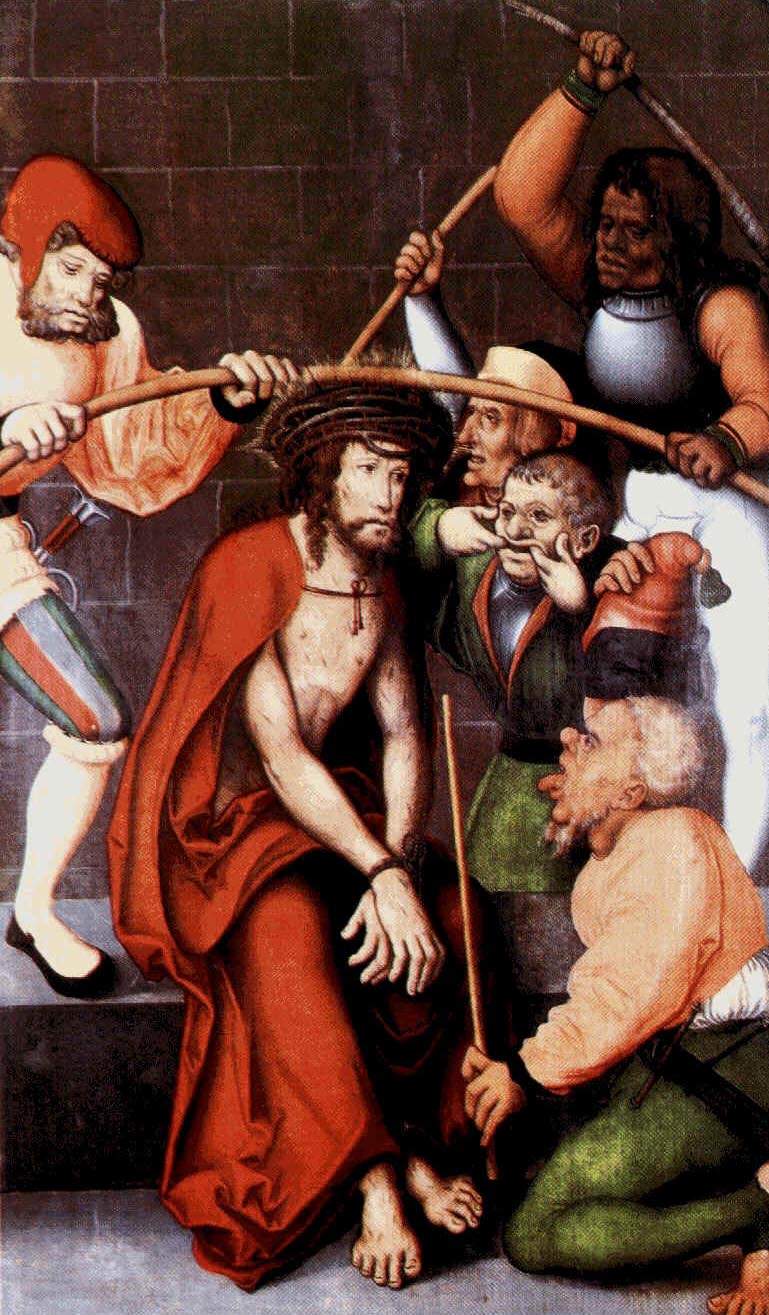
Cranach the Elder.

Immediately (and I mean immediately!), the basses trample over them with theatrical vigor, layered upon by each section in turn.  "Has the lightning and thunder stopped?  Fiery hell, open up and swallow them!"  Oh, and many other fun-to-sing German verbs are thrown in, too.  Of all the exciting and most stage-worthy choral moments, this one takes the cake.

What I love about Bach is that he is never afraid to acknowledge his angsty-German side.  Within a split second, his music can shift from despair about Jesus' capture to appall and rage, but it all serves the purpose of the Gospel message at the proper time.

Saturday, April 12, 2014

"Hey! Are you going to be busy this week?"


In one week, I have:

- played at four services, including a baptism
- played two dress rehearsals
- played two choir performances of the same
- rehearsed with four soloists
- taught a piano lesson
- led two choir rehearsals (senior and seminary)
- attended three choir rehearsals
- received two private lessons, piano and organ respectively
- baked three kinds of seminary treats
Okay, these were for myself.  Natural molasses-coconut oat energy bars.
- walked six miles to the grocery store and back, unwittingly
- recovered from a concussion on the ice, the day before all the ice decided to melt
This is what it looked like on April Fools' Day. Yep.

- learned how to use chopsticks with my left hand instead of right
- read almost half of Gerhard's On the Nature of Theology and Scripture
- realized that coconuts grow on palm trees.

Why does nothing interesting ever happen in my life?

Thursday, April 3, 2014

Easy as a mud-pie slice of cake.

No butter?  No eggs?  No oil?  No will to resist the unscraped bowl of cake batter?  No problem.

In kindergarten, my mom and I read A Birthday for Frances by Russell and Lillian Hoban as part of the curriculum, and this chocolate cake recipe constituted one of my homework projects.  Though I DID graduate kindergarten (whew!), my family kept baking up this one.


Here is the easiest chocolate cake you will make from scratch.

Chocolate "Mud Pie" Cake

Mix in one bowl:

  • 1-1/2 cups flour
  • 1 cup sugar
  • 1/4 cup unsweetened cocoa powder
  • 1 tsp. baking soda 
  • 1 tsp. salt
Mix in another bowl:
  • 1/3 cup applesauce
  • 1 tbsp. vinegar (Your choice.  I recommend balsamic.)
  • 1 tsp. vanilla
  • 1 cup water (I just swapped it for raspberry coffee and hazelnut creamer, and it turned out okay)
Combine the two.  The baking soda and vinegar will react with one another, and a chemical reaction will take place.  How educational.  

Bake in a 9-inch or 12-cupcake pan for 30-35 minutes at 350 degrees Fahrenheit.  Then eat the remaining batter with scrumptious relish.  Top with frosting if desired, and then lick that bowl as well.

Who are these beauties for, you might ask?  It's our synod president's birthday on Sunday, so I'm going to bring these to his office before then. 

 Maybe some of the others will have a chance to try them, too...

Saturday, March 29, 2014

Mid-Saturday musings

It's THAT day of the week.  I'll give you a hint:  opposite of church-musician Wednesdays and not quite our Sundays either.  After a quick stint as a person of Pinterest and oaty kitchen experimentation (and inventing the word "oaty"), I ran my usual 5k+, practiced Jan Bender's imitative, quartally-infused prelude on "Come, Ye Faithful," and read young-adult fiction on a sunny, cavernous library chair.


It could have held five of me.  At least one of us would have finished before dozing off.

I discovered ten other things this week:

1.  My usual running route, going down the parkway on the hill and turning around, has multiple ways of getting back up the hill. What.

2.  When I forget my music in choir, my sightreading experience is such that I can read my line off of a Soprano II's score across the room.

3.  Universal justification and objective justification differ from one another.

4.  Tiffany blue is one of the prettiest and most versatile colors.

5.  You miss the little, fidgety characteristics that bother you about someone first when he or she leaves.  Think about it.

6.  You can derive an individual's entire personality from how they sneeze.  I double-sneeze, so that must mean I'm bipolar.

7.  Tropical fruit topped with flake coconut, molasses and sunshine is the best antidote to a reluctant spring.

8.  One of the first classes taught in Music Skills should be standing in front of the photocopier, figuring out what way to turn the music book.

9.  Having a leaky sanctuary ceiling over where the baptismal font sits can be a self-fixing problem.

10.  Johann Gerhard's Theological Commonplaces set forth doctrine a lot more accessibly than other dogmatic expositions.  He likes to make lists, just as I do.  :)

How about you?


Monday, March 24, 2014

Mission Theology and the Image of God

A proper, Lutheran theology of missions easily centers around the concept and image of God because His being and attributes, as the source of everything good, contain everything needed to know about salvation. 

First, one should learn of His triune nature and its specific connection with the redemption story:  the Father sending His Son, the Son’s vicarious work, and the Holy Spirit’s bringing to faith and sanctifying.  Studying His power, one sees that He is able to provide everything necessary for salvation, and anything outside of Him is weak and powerless.  Examining His eternal nature, one understands Him as being beyond time, before sin started and lasting after sin ends.  In His immutability, the person should realize that He is the One that never changes, letting go of love for changeable, temporal possessions.  Connecting His immutability with His truthful nature, the new believer should understand that God is just, rewarding good and punishing evil, and that no error can be tolerated in His sight – unlike our wavering sense of morals.  Noting His omniscience, the person could and should see that the just Lord of all knows about every sin, closing any path of escape, but also that He knows the condition of the sinner’s deep degradation and exactly how to rescue him or her.  In His omnipresence, any place of “hiding” proves to be of no avail, but this also assures that God always knows our situation and how to protect us from any harm and danger. 

Looking at God’s love, anyone ought to be moved to love Him more and carry out love for others, knowing that He has set the ultimate example in the sending and self-sacrifice of His Son, and noticing nothing but self-service in the world.  Learning about His goodness, one should recognize that He alone supplies good in the world, and all other motivations and acts of men are driven by an evil, sinful heart. In His graciousness, one should compare His bestowing of goodness (ultimately eternal life) as a free gift aside from merit, whereas any human being requires some self-gratifying deed in return for another. 


Most of all, the person reached by this missionary theology should be taught that these features of the image of God are for him or her.  God’s image is the way it is without being dependent on man’s need or humanity, but He particularly determined for His attributes to work together, as we speak of it, to bring about our salvation as He willed it from eternity in time.  With instruction about the image of God, the new convert must discover that His characteristics that motivated our redemption from sin are like no other religion’s deity, including the theology of self.