In light of some issues that are being discussed in culture this Valentine's Day, let's reflect on what love is and isn't. Sometimes
Mutual consent does not justify a resulting crime. If someone is in a relationship where he or she suffers physical and emotional damage, it only sets forth his or her naivete when consenting earlier.
By fulfilling desires which inflict hurt on another, one is not showing "love" to the other person, but actually loving self. "So husbands ought to love their own wives as their own bodies; he who loves his wife loves himself. For no one ever hated his own flesh, but nourishes and cherishes it, just as the Lord does the church" (Ephesians 5:28-29). A man and woman in a relationship actively take an interest in the other's needs, and will not knowingly offend them by prioritizing self-servience. "Let each of you look out not only for his own interests, but also for the interests of others" (Philippians 2:4).
The ends do not justify the individual wrongs of the means ("redemption stories"). In the rare event that a wrongdoer is turned from his or her sin, that does not automatically excuse his or her own active sinful behavior in the process, or the passive sinful behavior of the other abetting the active sin. In the event that this redemption story is a fictional book or movie, appreciators of the work may use the consummation to excuse themselves, indulging in filling their minds with sin for a couple of hours. This doesn't reverse the damage done along the way.
Ideas have consequences. Bad ideas propagated from bad motives equal bad consequences. Subjective fantasies may be cloaked as harmless, but they can cause objective spiritual and physical scars. In theory, one can enjoy a customized, self-gratifying lifestyle, but in practice, people get hurt and
What is God's purpose for a romantic relationship? It's not there to make YOU feel better, first and foremost. It is to cherish and care for another human being (and possible children!), also dealing with a sinful nature. In marriage a man and woman make this promise to one another, and even if the happy feelings aren't there once in a while, they still show love. This depicts Christ's unchanging love for the church, which He doubly promises (Hebrews 6:17-18). Through Him alone can we receive forgiveness for our selfishness and draw the strength to put others first.
I don't know how you usually spend Valentine's Day. I have been single every February of my life, so today I invented a decently tasty chocolate cake, sang hymns at a nursing home with friends, and picked up coffee with my brother. Expressing kindness and forgiveness toward those around you (Ephesians 4:32) can take the form of romance, relations, or friendships. Yet, remember this: in the only true love story, only one innocent Person suffered.
Beware lest anyone cheat you through philosophy and empty deceit, according to the tradition of men, according to the basic principles of the world, and not according to Christ (Colossians 2:8).
Saturday, February 14, 2015

Wednesday, December 31, 2014
'14 and '15 favorites
Fourteen amazing things that happened to me last year:
- Completing Round 1 of grad school, and reaching the halfway point! MCM, organ emphasis: 3.7. MA in Lutheran Theological Studies: 3.38.
-. Running by Lake Superior over choir tour and by Lake Michigan during my summer program, listening to the Mass in b minor.

- Being a personal attendant for a wedding, playing piano for some other friends' wedding, and playing organ for still another friend's wedding.

- Performing a coffee-themed collaborative piano recital. Win.
- Trying caviar sushi, escargot, Sriracha sauce, a "cable car," coconut oil, crayfish, two-person sized chocolate cake, papayas, and most gluten-free food (after cutting out gluten!)

- Learning what Heinrich Schuetz's Musikalische Exequien is, and how to pronounce it. Third movement.
- Getting to know two special (and hilarious!) guys at grad school. Happy trees! NYstedt! Musica ficta!

- Finally getting to see Spoonbridge and Cherry by Claes Oldenburg, Split Rock Lighthouse, the Duluth Liftbridge, a cruise on Lake Superior, and Chanhassen Dinner Theatres for the first time!

- Completing losing my NOOK tablet at a restaurant, only to have the kind staff mail it back to me a month later without harm.
- Landing a position at my alma mater's library for night shifts (AND doing all my dogmatics homework!).


- Accompanying all the choirs plus ringing bells for my alma mater's Christmas concerts.
- Teaching a children's choir how to sing in PARTS (yes, you guys) and getting the sweetest thank-yous and Christmas gifts from them. So worth it...with an eternal blessing.

Fifteen great things I pray will happen (and happen well) next year:
- Turning 23 on the 23rd.
- My MCM recital and MA thesis.
- Completing master's degree No. 1.
- Learning how to do quality research.
- Accompanying at least two solo recitals.
- Traveling with a musical purpose?
- Something cantata-related. :)
- Making a new friend (or two or more).
- Making acquaintances better friends.
- Giving a hymnology presentation to the Synod at the yearly convention.
- Having the privilege of being a bridesmaid or godmother (or both).
- Learning German.
- Ending up someplace completely unprecedented...in a serendipitous way.
- Truly caring for everyone I know and with whom I work, as people God has redeemed.
- Growing stronger in repentance and faith in my Savior, Christ Jesus. Seminary has only shown what a "bad" Christian I really am - my worthiness by being theologically involved does NOT earn me anything better.
Now may the God of peace who brought up our Lord Jesus from the dead, that great Shepherd of the sheep, through the blood of the everlasting covenant, make you complete in every good work to do His will, working in you[ what is well pleasing in His sight, through Jesus Christ, to whom be glory forever and ever. Amen. Hebrews 13:20-21
- Completing Round 1 of grad school, and reaching the halfway point! MCM, organ emphasis: 3.7. MA in Lutheran Theological Studies: 3.38.
-. Running by Lake Superior over choir tour and by Lake Michigan during my summer program, listening to the Mass in b minor.
- Being a personal attendant for a wedding, playing piano for some other friends' wedding, and playing organ for still another friend's wedding.
- Performing a coffee-themed collaborative piano recital. Win.
- Trying caviar sushi, escargot, Sriracha sauce, a "cable car," coconut oil, crayfish, two-person sized chocolate cake, papayas, and most gluten-free food (after cutting out gluten!)
- Getting to know two special (and hilarious!) guys at grad school. Happy trees! NYstedt! Musica ficta!
- Finally getting to see Spoonbridge and Cherry by Claes Oldenburg, Split Rock Lighthouse, the Duluth Liftbridge, a cruise on Lake Superior, and Chanhassen Dinner Theatres for the first time!
- Completing losing my NOOK tablet at a restaurant, only to have the kind staff mail it back to me a month later without harm.
- Landing a position at my alma mater's library for night shifts (AND doing all my dogmatics homework!).
- Obtaining my driver's license and the use of my parents' Camry.
- Hearing a hymn I wrote sung at my friends' wedding.
- Accompanying all the choirs plus ringing bells for my alma mater's Christmas concerts.
- Teaching a children's choir how to sing in PARTS (yes, you guys) and getting the sweetest thank-yous and Christmas gifts from them. So worth it...with an eternal blessing.
Fifteen great things I pray will happen (and happen well) next year:
- Turning 23 on the 23rd.
- My MCM recital and MA thesis.
- Completing master's degree No. 1.
- Learning how to do quality research.
- Accompanying at least two solo recitals.
- Traveling with a musical purpose?
- Something cantata-related. :)
- Making a new friend (or two or more).
- Making acquaintances better friends.
- Giving a hymnology presentation to the Synod at the yearly convention.
- Having the privilege of being a bridesmaid or godmother (or both).
- Learning German.
- Ending up someplace completely unprecedented...in a serendipitous way.
- Truly caring for everyone I know and with whom I work, as people God has redeemed.
- Growing stronger in repentance and faith in my Savior, Christ Jesus. Seminary has only shown what a "bad" Christian I really am - my worthiness by being theologically involved does NOT earn me anything better.
 |
| Someone surprised me with this on my birthday! A real God-send. :) |
Monday, December 29, 2014
Cantata No. 182: the cute one

I've got news for you. Bach did write cantatas for performance during Lent.
Say what?
Though all instrumentalists were out of service until Easter morning and its explosion of trumpets and D Major, Germans in the Baroque era still employed music for Annunciation on March 25, which is always a happy thing. In that wonderful instance in which Easter landed on April 1, you get - a Palm Sunday cantata! Learned something new, didn't you?
So, if you are going to get away with exciting music before Lent is over, you might as well make it worthwhile and tie in all the Holy Week references imaginable. No, not lop-eared rabbits in baskets. Still, symbols of springtime aside, this piece is overwhelmingly "cute." Hard to articulate unless you are listening, but it is far better than baby animals.
Once again, this is an extremely early Weimar cantata, put together when J.S. Bach was still figuring out his style. A simplified instrumentation of recorder, concertato and ripieno violin, two violas, cello, and keyboard render its performance quite feasible, and produce a charming sound. On Emmanuel Music's program notes, Craig Smith describes that the sinfonia has the "sound of early morning about it," which is the most fitting image I can put to it. Welcoming Jesus' procession into Jerusalem, the lower strings pluck while the three soprano instruments alternate a charming dotted rhythm (French overture!), with all picking it up arco at the end. It is hard not to like this - exactly like Christ's gentle and humble entrance.
Its second movement follows through with Jesus (the bass) responding to the question- "See, I come! - in the Book it is written of me..." then resuming in chant style: "Your will, my God, my God, my God, I do gladly," with an eagerly rippling cello figure underneath. The held cadences on the word "gladly" seem to accentuate it. "My God" is repeated three times - Trinitarian reference?
Using strong triadic forces, the bass, now the role of the firm believer in Christ, sings "Strong love, which, great Son of God, has thrown You from the throne of Your glory," "throwing down" with an octave dominant cadence. Continuing on, "Strong love, that You, for the salvation of the world, might be a Sacrifice which You have prescribed with Your own blood." Unlike several English translations, the German indeed says "presented as a Sacrifice," not "sacrificed." Theologically, this is a necessary distinction. "No man takes (My life) from Me; I lay it down of myself" (John 10:18). At the forementioning of bloodshed, Bach notes "piano" as if disclosing an Old Testament mystery, and cross-motifs emerge in the solo as well as the violin concertato and jagged continuo.
The alto aria integrates the natural result of sanctification after receiving this salvation, comparing rendering one's life as a "living sacrifice" (Romans 10:2) to the laying down of garments on the Jerusalem road. Outlining many diminished sevenths, the voice and solo flute imitate one another, and at the Andante the "repentant" alto character describes how this spotless garment of body, life (with an extended, breathy melisma) and desires must be subject to the King (going up for a high note in the melodic contour).
The tenor sails confidently through good and bad, illustrated by madly modulating running notes in the cello. "Though the world only scream 'Crucify!' do not let me flee, Lord, from your cross' banner, I find crown and palm here." Crucifixion here, of course, involves fully-dimished sevenths, but also a four-note pattern with 1-2 and 3-4 seconds in the same direction, with 2-3 a third in the opposite direction. "Cross' banner" uses a melodic variation of the fully-diminished seventh intervals. "Crown and palm" straightens out to the sturdiest of arpeggiated thirds.
Looking into the upcoming Passion week, for which Bach would not be able to provide Lenten music, the full choir introduces a fugue on "Jesus, I Will Ponder Now," verse 33, with vorimitation in tenor and bass before the soprano cantus firmus, then alto. Even the entrance order is cross-shaped!
"Joy" ends each subject with a laughing turn; "pasture" in the next phrase a lively rise and fall. "My soul walks on roses" uses syncopation in all parts to get the "skipping" idea across. This is very hard to catch unless you are following the score closely, but in the alto part preceding the last soprano entrance on the word "sake" (referring to the cross), there is a cross motif.
Walking by faith on Jesus' robe of righteousness, everyone calls out, "Now let us go into the Salem of joy!" in a bright G-Major gigue. Accompanying the King in not only love, but also suffering is shown by a quick alteration to minor, speedily recovering to major in a mere measure. Such is the Christian life under the cross - on the way to heaven all experience earthly sorrow, but in view of this joy it disappears in a moment. The basses have the first entrance in "He goes before and opens the path," before everyone else jumps in at once. Coincidence? Not likely.
Listen for yourself! Have a lovely day, and imagine it's spring (or that you are surrounded in palm trees)
Score: http://imslp.org/imglnks/usimg/a/ad/IMSLP01444-BWV0182.pdf
Translation: http://emmanuelmusic.org/notes_translations/translations_cantata/t_bwv182.htm#pab1_7
Recording: http://imslp.org/imglnks/usimg/a/ad/IMSLP01444-BWV0182.pdf

Sunday, November 23, 2014
A wedding song of love known
Two of my friends just got married! All of us graduated from the same college, were born within a month apart, and got involved in the same musical ensembles. Sharing an appreciation for good hymnody, the groom asked me to pen additional verses to "My Song Is Love Unknown," tying it into the wedding ceremony. Delving into Ephesians 5, I attempted to include more Lutheran - and Scriptural :) - concepts of love.
On this my wedding day
I praise this love divine
For sending me a friend
Who is now truly mine
Let me this love
For all our days
Share as it is is in heaven above.
And like this love, I pray
Help me to show it well
To this one dear to me
For all my days, and tell
His untold grace
His dying love
Until at last we see His face.
Lord Jesus, enter now
Our hearts this wedding day
Through Sacrament and Word
Guide us now and always
Your grace alone
By faith in You
Will bless and keep our joyous home.
Through Him this love is known
I share that love with you
And as He wills, may all our days
Spring forth that joy anew
By faith alone
He holds us dear
Until we reach His heavenly throne.
As Christ cherished his bride
So may I love my wife
Protect and care for her
As I do my own life
God, please impart
This strength to me
To sacrifice my selfish heart
Through human strength alone
I cannot show this love
The Spirit, yet, by faith
Endows it from above
The Father's Son
His love has giv'n
It is through Him our works are done.
Our marriage may He bless
Bestow with grace our home
Until we know as we are known
The holy Word
And Sacrament
Will guide us till we see our Lord.
"By this we know love, because He laid down His life for us. And we also ought to lay down our lives for the brethren" (1 John 3:16). We can know true love as it is revealed in God's Word - the simple Gospel message of Christ's substitutionary satisfaction which frees us from the power of sin. Understanding this supreme love makes for a different case - we cannot, in our sinful state, take in why He has elected us from eternity, but the Holy Spirit moves us to confess that it is true. Additionally, He promises to keep us in that grace and bring forth good fruits (such as love toward others) until we see Him face-to-face.
SDG, and enjoy!

SDG, and enjoy!
Sunday, October 26, 2014
Wake, awake! A LOT to celebrate.
Too many things going on this Sunday! I don't know about you, but we celebrated Reformation Sunday in church today (even though the 31st is Thursday). Also, it's National Pumpkin Day, so I threw together a raw, organic, gluten-free pumpkin cheesecake before church, plus got my pumpkin fix at the Barnes and Noble Cafe with the bro. Excellent morning. Did I mention we sang most of the Luther ordinary hymns? :D
On top of that, it's Philipp Nicolai's birthday, commemorated along with Paul Gerhardt and Johann Heermann as the three great early Lutheran hymnwriters.
Philipp Nicolai grew up during the period of Lutheran Orthodoxy in Germany, living in the town of Waldeck. As a pastor's son, he became inspired to attend the universities of Erfurt and Leipzig (the conservative place to get educated) in order to enter the ministry as well. In 1583 at Herdecke he began his first ordained post, but pressure from the Catholics soon encouraged him to go elsewhere. After that, he continued to hold a variety of roles within his vocation, such as private preacher to a countess, tutor, and deacon, but soon entangled himself in a theological debate with the Calvinists over the true physical presence of Christ's flesh in the Lord's Supper. Starting in 1597, the plague hit Unna, his current post, and in constant view of this he ushered in a new type of hymnody, more first-person and devotional, with "Joy-Mirror of Eternal Life," his reflective book containing three hymns - "Wake, Awake, For Night Is Flying" and "How Lovely Shines the Morning Star" the two that are commonly sung in America today.
The first, the King of Chorales, might possibly be based on a chant melody, but if nothing else Nicolai evokes the excited tone of the watchmen in highlighting the major triad. Metrically, it retells the Matthew 25 account of the blessed and foolish virgins awaiting the Bridegroom through the night, proceeding into the glory of Christ's eternal marriage feast. Compared to "Day of Wrath," the sequence hymn describing the terrors of redeemed-but-not-saved persons in judgment, this hymn paints Christ the King's return as a happy occasion for believers, in which they should be confident in their sainthood according to His merit.
http://www.hymnary.org/hymn/ELH1996/544
The second, the Queen of Chorales, also continues the celebratory wedding metaphors, freely based on Psalm 45. It became so popular that its verses were engraved on household items, it was considered essential to the wedding service, Holy Communion, and funerals. Johann Gerhard prayed the seventh verse ("Oh joy, to know that Thou, my Friend...") when dying. Additionally, the tunes is used for the Exordium hymn on the festivals of Christmas ("Rejoice, Rejoice This Happy Morn"), Easter ("He Is Arisen! Glorious Word") and Pentecost ("O Holy Spirit, Enter In").
http://www.hymnary.org/hymn/ELH1996/167
Collect for the day: Almighty God, who through Your holy apostle have taught us to praise You in psalms and hymns and spiritual songs: We give You thanks this day for the gift of writing hymns which You gave to Your servants Philipp Nicolai, Johann Heermann, and Paul Gerhardt; and we pray that Your Church may never lack those with the gifts of writing words and music to Your praise, and may be ever filled with the desire to praise and thank You for your great goodness; through Jesus Christ our Lord, who lives and reigns with You and the Holy Spirit, one God, now and forever.
Amen.
On top of that, it's Philipp Nicolai's birthday, commemorated along with Paul Gerhardt and Johann Heermann as the three great early Lutheran hymnwriters.
 |
| Philipp Nicolai (1556-1608) |
The first, the King of Chorales, might possibly be based on a chant melody, but if nothing else Nicolai evokes the excited tone of the watchmen in highlighting the major triad. Metrically, it retells the Matthew 25 account of the blessed and foolish virgins awaiting the Bridegroom through the night, proceeding into the glory of Christ's eternal marriage feast. Compared to "Day of Wrath," the sequence hymn describing the terrors of redeemed-but-not-saved persons in judgment, this hymn paints Christ the King's return as a happy occasion for believers, in which they should be confident in their sainthood according to His merit.
http://www.hymnary.org/hymn/ELH1996/544
The second, the Queen of Chorales, also continues the celebratory wedding metaphors, freely based on Psalm 45. It became so popular that its verses were engraved on household items, it was considered essential to the wedding service, Holy Communion, and funerals. Johann Gerhard prayed the seventh verse ("Oh joy, to know that Thou, my Friend...") when dying. Additionally, the tunes is used for the Exordium hymn on the festivals of Christmas ("Rejoice, Rejoice This Happy Morn"), Easter ("He Is Arisen! Glorious Word") and Pentecost ("O Holy Spirit, Enter In").
http://www.hymnary.org/hymn/ELH1996/167
Collect for the day: Almighty God, who through Your holy apostle have taught us to praise You in psalms and hymns and spiritual songs: We give You thanks this day for the gift of writing hymns which You gave to Your servants Philipp Nicolai, Johann Heermann, and Paul Gerhardt; and we pray that Your Church may never lack those with the gifts of writing words and music to Your praise, and may be ever filled with the desire to praise and thank You for your great goodness; through Jesus Christ our Lord, who lives and reigns with You and the Holy Spirit, one God, now and forever.
Amen.
 |
| St. Katherine's in Hamburg, the last church at which Nicolai served |
Thursday, September 25, 2014
You know you're "beaned" when...

You know you're beaned when you get bored and make coffee at 10 p.m., just because you're bored and want to fall asleep to the smell.
You use empty coffee bags as drawer sachets.
You look up what order to order your itemized list in a beverage (the one presented on the cup, starting with size of course).
You have tried mixing light and dark roast together to make medium roast, and it doesn't work.
Your heart leaps with joy when you see Caribou has texted you...except it's not the $2 medium drink for which you hoped.
You have spilled coffee on every white piece of clothing you own (bonus points: your wedding dress).
You know that Folgers is seriously shooting itself in the foot by being in a plastic canister, not a bag lined in foil.
You remove your coffee grounds from the bag and put them into an individual, sterilized jar.
You can't tell whether or not gas has leaked in your apartment because it smells so strongly of coffee.
Chocolate-covered espresso beans are the ultimate treat.
You know that Caribou gives free refills of the "on tap" roasts with purchase of a specialty drink.
You give a piano recital that is coffee-themed.
Every time you think of the "Coffee Cantata" you start cracking up because you realize that J.S. Bach seriously wrote that.

You tell your tea-drinking, owl-loving friends (because that's how they come) that no, you're not too caffeinated, coffee has way more health benefits anyway.

You drink the first cup just to get started, the second to warm yourself up, and the third to actually work.
You meet another person who thinks they love coffee more than you, and you inwardly laugh to yourself.
You can distinguish a peculiar taste to decaf, somewhat reminiscent of marinara sauce.
 You have so frenziedly made coffee that you forgot the water/filter/grounds/all of the above.
 You have coffee grounds in every drawer of your pantry, with no recollection of how they got there.
You know what Cuban coffee is and it is the best stuff you will have in your life.
You consider ways of incorporating coffee into your wedding theme.

You have ordered beans directly from Hawaii and not even bothered to note the shipping costs.
You like dark beer mainly because it reminds you of coffee.
You were so pumped to have come up with this list, you wrote a note about it to celebrate.
I must be beaned.
Monday, September 8, 2014
Knut Nystedt: Immortal Bach
What if you could recompose your favorite J.S. Bach piece? What parts of the piece would you play around just to see what it would sound like, because you hear it a certain way when you listen to it?

What if you could keep Bach's timeless music from decomposing?
Knut Nystedt's 1988 work, Immortal Bach, attempts precisely that. Surprise! The harmonization parades itself as a classic isometric chorale setting by the composer as of cantata finale movements, but the original is a solo voice and continuo setting included in Georg Christian Schemelli's Gesangbuch of 1736.
Supplying a four-part harmonization for the first three phrases, you would think the composer had revived Bach enough to make Felix Mendelssohn click the "like" button.
Not so! There's more!
 The instructions for the chorale set it apart, and make music theory lovers like myself shiver with joy. In performance, all vocalists sing the first chord for 4 seconds, then progress at different rates - some continue at 4 seconds per quarter notes, but others for 6, 8, 10, or 12 seconds. Once the first group reaches the cadential chord, they wait until everyone else resolves to it, and release together. The same procedure applies to the rest of the phrases - things get very interesting sonorically with the eighth-note passing tones. Depending on the recording, the chorale may be sung before (Nystedt) or after (which I prefer for better contrast).
Come, sweet death;
Come, blessed rest;
Come, lead me in peace!
Just when it seems like nothing can get better than 18th-century counterpoint, someone adds a spatula and kaleidoscopes all of the harmonic possibilities so we can hear them.

I wonder what text-painting the composer has in mind?
Recording: https://www.youtube.com/watch?v=pftYqg6iyvQ

What if you could keep Bach's timeless music from decomposing?
Knut Nystedt's 1988 work, Immortal Bach, attempts precisely that. Surprise! The harmonization parades itself as a classic isometric chorale setting by the composer as of cantata finale movements, but the original is a solo voice and continuo setting included in Georg Christian Schemelli's Gesangbuch of 1736.
 |
| Original. Not kidding. |
Not so! There's more!
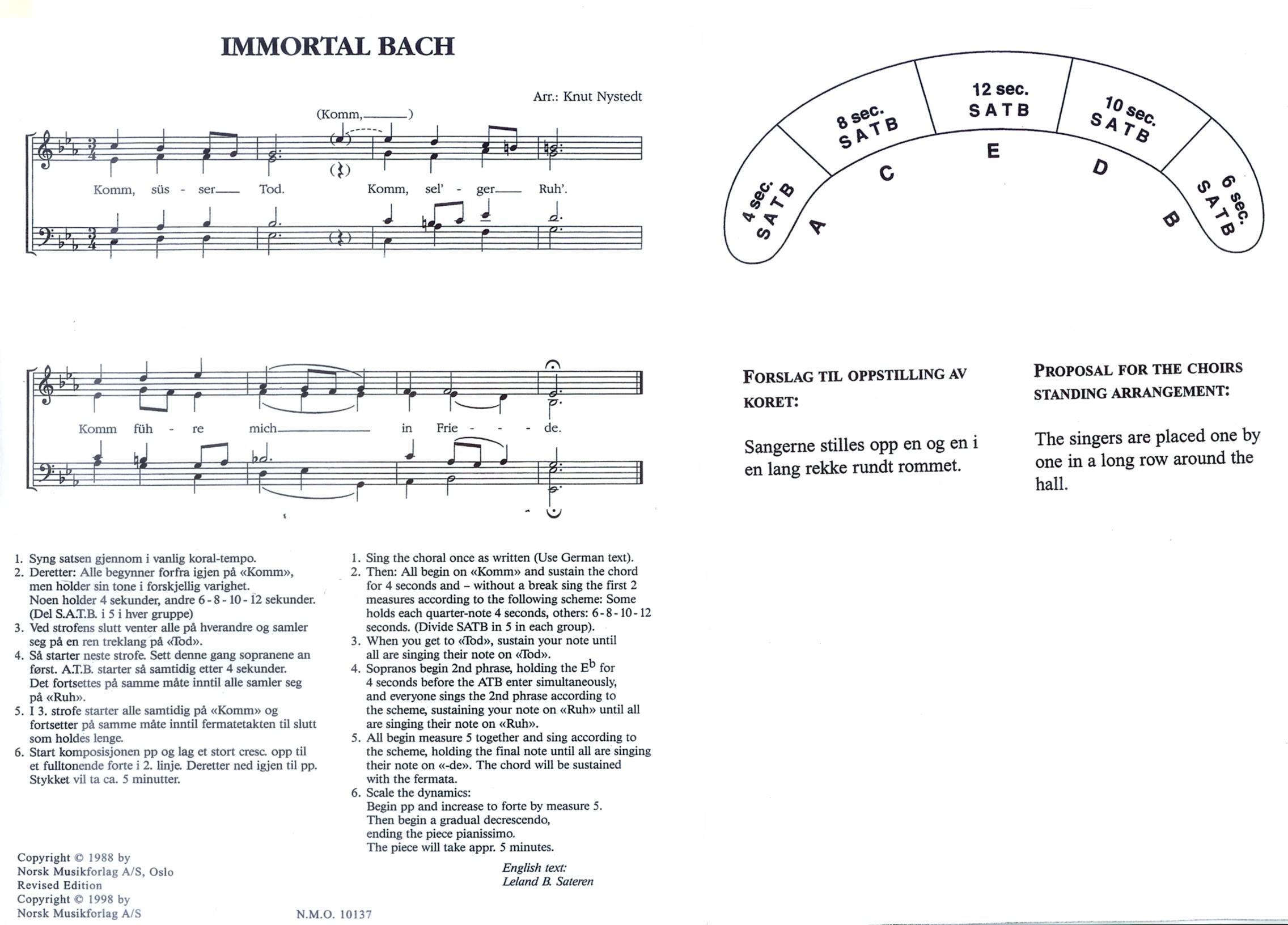 The instructions for the chorale set it apart, and make music theory lovers like myself shiver with joy. In performance, all vocalists sing the first chord for 4 seconds, then progress at different rates - some continue at 4 seconds per quarter notes, but others for 6, 8, 10, or 12 seconds. Once the first group reaches the cadential chord, they wait until everyone else resolves to it, and release together. The same procedure applies to the rest of the phrases - things get very interesting sonorically with the eighth-note passing tones. Depending on the recording, the chorale may be sung before (Nystedt) or after (which I prefer for better contrast).
 Come, sweet death;
Come, blessed rest;
Come, lead me in peace!
Just when it seems like nothing can get better than 18th-century counterpoint, someone adds a spatula and kaleidoscopes all of the harmonic possibilities so we can hear them.

I wonder what text-painting the composer has in mind?
Recording: https://www.youtube.com/watch?v=pftYqg6iyvQ
Subscribe to:
Posts (Atom)