Sunday, October 26, 2014

Wake, awake! A LOT to celebrate.

Too many things going on this Sunday!  I don't know about you, but we celebrated Reformation Sunday in church today (even though the 31st is Thursday).  Also, it's National Pumpkin Day, so I threw together a raw, organic, gluten-free pumpkin cheesecake before church, plus got my pumpkin fix at the Barnes and Noble Cafe with the bro.  Excellent morning.  Did I mention we sang most of the Luther ordinary hymns?  :D

On top of that, it's Philipp Nicolai's birthday, commemorated along with Paul Gerhardt and Johann Heermann as the three great early Lutheran hymnwriters.

Philipp Nicolai (1556-1608)
Philipp Nicolai grew up during the period of Lutheran Orthodoxy in Germany, living in the town of Waldeck.  As a pastor's son, he became inspired to attend the universities of Erfurt and Leipzig (the conservative place to get educated) in order to enter the ministry as well.  In 1583 at Herdecke he began his first ordained post, but pressure from the Catholics soon encouraged him to go elsewhere.  After that, he continued to hold a variety of roles within his vocation, such as private preacher to a countess, tutor, and deacon, but soon entangled himself in a theological debate with the Calvinists over the true physical presence of Christ's flesh in the Lord's Supper.  Starting in 1597, the plague hit Unna, his current post, and in constant view of this he ushered in a new type of hymnody, more first-person and devotional, with "Joy-Mirror of Eternal Life," his reflective book containing three hymns - "Wake, Awake, For Night Is Flying" and "How Lovely Shines the Morning Star" the two that are commonly sung in America today.

The first, the King of Chorales, might possibly be based on a chant melody, but if nothing else Nicolai evokes the excited tone of the watchmen in highlighting the major triad.  Metrically, it retells the Matthew 25 account of the blessed and foolish virgins awaiting the Bridegroom through the night, proceeding into the glory of Christ's eternal marriage feast. Compared to "Day of Wrath," the sequence hymn describing the terrors of redeemed-but-not-saved persons in judgment, this hymn paints Christ the King's return as a happy occasion for believers, in which they should be confident in their sainthood according to His merit.

http://www.hymnary.org/hymn/ELH1996/544

The second, the Queen of Chorales, also continues the celebratory wedding metaphors, freely based on Psalm 45.  It became so popular that its verses were engraved on household items, it was considered essential to the wedding service, Holy Communion, and funerals.  Johann Gerhard prayed the seventh verse ("Oh joy, to know that Thou, my Friend...") when dying.  Additionally, the tunes is used for the Exordium hymn on the festivals of Christmas ("Rejoice, Rejoice This Happy Morn"), Easter ("He Is Arisen! Glorious Word") and Pentecost ("O Holy Spirit, Enter In").

http://www.hymnary.org/hymn/ELH1996/167

Collect for the day:  Almighty God, who through Your holy apostle have taught us to praise You in psalms and hymns and spiritual songs: We give You thanks this day for the gift of writing hymns which You gave to Your servants Philipp Nicolai, Johann Heermann, and Paul Gerhardt; and we pray that Your Church may never lack those with the gifts of writing words and music to Your praise, and may be ever filled with the desire to praise and thank You for your great goodness; through Jesus Christ our Lord, who lives and reigns with You and the Holy Spirit, one God, now and forever.
 Amen.
St. Katherine's in Hamburg, the last church at which Nicolai served

Thursday, September 25, 2014

You know you're "beaned" when...


You know you're beaned when you get bored and make coffee at 10 p.m., just because you're bored and want to fall asleep to the smell.

You use empty coffee bags as drawer sachets.

You look up what order to order your itemized list in a beverage (the one presented on the cup, starting with size of course).

You have tried mixing light and dark roast together to make medium roast, and it doesn't work.

Your heart leaps with joy when you see Caribou has texted you...except it's not the $2 medium drink for which you hoped.

You have spilled coffee on every white piece of clothing you own (bonus points:  your wedding dress).

You know that Folgers is seriously shooting itself in the foot by being in a plastic canister, not a bag lined in foil.

You remove your coffee grounds from the bag and put them into an individual, sterilized jar.

You can't tell whether or not gas has leaked in your apartment because it smells so strongly of coffee.

Chocolate-covered espresso beans are the ultimate treat.

You know that Caribou gives free refills of the "on tap" roasts with purchase of a specialty drink.

You give a piano recital that is coffee-themed.

Every time you think of the "Coffee Cantata" you start cracking up because you realize that J.S. Bach seriously wrote that.


You tell your tea-drinking, owl-loving friends (because that's how they come) that no, you're not too caffeinated, coffee has way more health benefits anyway.

You drink the first cup just to get started, the second to warm yourself up, and the third to actually work.

You meet another person who thinks they love coffee more than you, and you inwardly laugh to yourself.


You can distinguish a peculiar taste to decaf, somewhat reminiscent of marinara sauce.

You have so frenziedly made coffee that you forgot the water/filter/grounds/all of the above.

You have coffee grounds in every drawer of your pantry, with no recollection of how they got there.

You know what Cuban coffee is and it is the best stuff you will have in your life.

You consider ways of incorporating coffee into your wedding theme.


You have ordered beans directly from Hawaii and not even bothered to note the shipping costs.

You like dark beer mainly because it reminds you of coffee.

You were so pumped to have come up with this list, you wrote a note about it to celebrate.

I must be beaned.

Monday, September 8, 2014

Knut Nystedt: Immortal Bach

What if you could recompose your favorite J.S. Bach piece?  What parts of the piece would you play around just to see what it would sound like, because you hear it a certain way when you listen to it?

What if you could keep Bach's timeless music from decomposing?

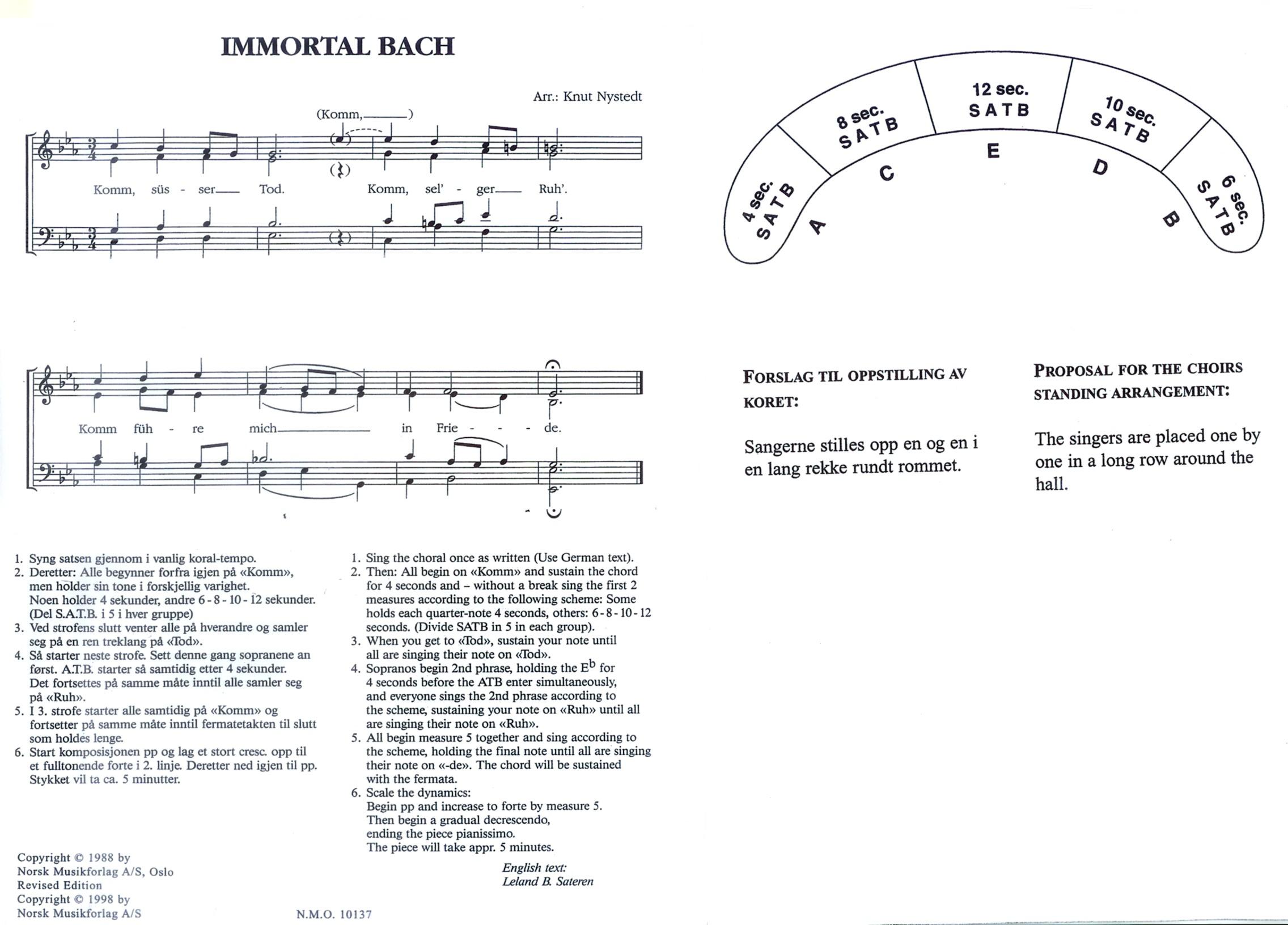
Knut Nystedt's 1988 work, Immortal Bach, attempts precisely that.  Surprise!  The harmonization parades itself as a classic isometric chorale setting by the composer as of cantata finale movements, but the original is a solo voice and continuo setting included in Georg Christian Schemelli's Gesangbuch of 1736.

Original.  Not kidding.
Supplying a four-part harmonization for the first three phrases, you would think the composer had revived Bach enough to make Felix Mendelssohn click the "like" button.

Not so!  There's more!


The instructions for the chorale set it apart, and make music theory lovers like myself shiver with joy.  In performance, all vocalists sing the first chord for 4 seconds, then progress at different rates - some continue at 4 seconds per quarter notes, but others for 6, 8, 10, or 12 seconds.  Once the first group reaches the cadential chord, they wait until everyone else resolves to it, and release together.  The same procedure applies to the rest of the phrases - things get very interesting sonorically with the eighth-note passing tones.  Depending on the recording, the chorale may be sung before (Nystedt) or after (which I prefer for better contrast).

Come, sweet death;
Come, blessed rest;
Come, lead me in peace!


Just when it seems like nothing can get better than 18th-century counterpoint, someone adds a spatula and kaleidoscopes all of the harmonic possibilities so we can hear them.


I wonder what text-painting the composer has in mind?

Recording:  https://www.youtube.com/watch?v=pftYqg6iyvQ

Saturday, August 16, 2014

Can we have the sharp sign back now?


If you routinely hashtag, you may fully disagree with this post.  I understand, and that is your choice. Still, let me explain why I don't use them on social media (as well as the Facebook "like" button or Twitter "@," but those are different posts).

Coherence:

You are reading this sentence in your normal voice.  #nowyourereadingitinalowmonotoneandfastvoice.  

See how that broke up the flow?  When a person reads something internally and it's peppered with hashtags, it is less coherent and harder to follow.  In writing, I try to write as if I was speaking out loud - then I am more well-rehearsed in coherent conversation when I do.  Keep this change of tone in mind as you read the rest.

Credibility:  I have a few friends well-versed in communication and promotion - they know how to utilize social media, and they can get away with #hashtagsoneverything #andstill #itmakessense.  For the other 90% of the symbol's manipulators, it juices the serious tone out of whatever you just said.

My skills in marketing and interpersonal relations have been honed by twenty years of service experience in a developing company.  I strive to be resourceful and professional in each task.  #hireme

Practicality:  Originally, the hashtag was invented for Twitter usage to group posts by topic - then, someone could search a "trending" news item and see them more clearly organized.  It quickly lost this function, however, and people started thinking of it as a dress-up function for their updates.

This is what I have to say, and because I'm one of these people, I'm #hashtaggingendsofeverysentence.  
So then Facebook users started doing it.  Sorry guys, it doesn't work.  Oh wait.  They MADE it work.  In most cases, though, it ends up being word clutter, and harder to see the real meaning.  #excessive #redundant  #superfluous

Literary Technique:  Some might aver that hashtags are their own literary form of writing - you express something and add a few more ideas at the end.  #context  #justforkicks.  Still, social media followers are reading this in their heads over and over, and then it turns into speech in real life - ergo the song "#SELFIE."

Could we just show culture what it means to converse meaningfully?  If you have a thought, presenting it in a way that conveys a direct message instead of #together #adding #stringing #ideas #order #in #random.

Happy 60th Birthday to my dad!  I thank God every day for your example of sacrifice and love in my life.  Your appreciation of books, patience with my parking skills, and Scrabble wits inspire me to learn.  Enjoy the cake!

Happy birthday, Dad!  #60 #example #Scrabble #literary #hetakesthecake


Disambiguation:  Before the hashtag, the symbol indicated other extremely common things, such as pounds, numbers, or to the entire world of music, SHARPS.  Now, children learning to play tic-tac-toe or music students playing C# Major pieces in an atonal key signature are quite confused.  Well, we were there first.

Finally, there's something I need to get off my chest.

#isasharp #7thinharmonicminor #6thinmelodic #impliescontinuosecondarydominant #musicaficta

Whew.  You know, maybe the musicians need to start a trending discussion using flat symbols.  Then everything would be natural again.


Tuesday, August 5, 2014

The church that wouldn't sing

"I have no pleasure in any man who despises music.  It is no invention of ours; it is the gift of God." - Martin Luther

Dear Pastor:

About a month ago, two of my friends and I visited your church once while in town.  Looking for a congregation of my fellowship at which to hear God's Word and worship, I did research and found your parish, and it appeared to be a promising, confessional Lutheran assembly.

Settling into our pew near the back of the ornate, historical sanctuary and locating hymnals, we were instructed by the HD flatscreen to join in hymn 593.  We did so.  Glancing about the room, I was shocked - not one member of the 20 or so present sang along.  Perhaps about half of them had hymnals open and were leaning over to read the words, yet no lip movement.  The others, all of whom were seated towards the west end of the church, faced straight ahead.

My friends and I continued along, leading the hymn in equal volume to the organ, splitting into parts, adding a descant, and so on as we were used to doing.  The sermon ironically concentrated on enthusiastic outreach to the community, and consisted of primarily third function of the law - not misfitting within context.  To close the service, you and your vicar planned to supplement the message on evangelism with a video on abovementioned flatscreen, but after a solid five-plus minutes of attempts, the presentation was adjourned.

Following the benediction, a woman in front of me, who had been silent for the whole hour next to her restless teenage son, turned around and complimented me on my singing voice, interested in knowing if we were musically trained.  I explained to her that although I am an organ major and have had limited vocal instruction, I enjoy singing hymns and think it is an important part of the Divine Service.  Upon shaking your hand, Pastor, I thanked you for chanting the cantor's part in the psalm.  You apologized for your weak singing voice, but I tried to encourage you for setting a good example for your church.

What we saw and didn't hear was disappointing, not because we were graduate music majors, but because we were Christians who believe that hymnody and liturgy is a central part of worship.  It has nothing to do with how "well" people can sing.  If anyone thought he or she could please God or be a better Christian by the quality of the sacrifice - if that is how congregational song is viewed - there is no way even I could impress God.  Yes, to some extent worship concerns rendering the Lord His due honor, as expressed in Scripture, but even that is for our edification as well. A church musician named Louis G. Nuechterlein wrote, "The music of the congregation derives from the triangular shape of Christian worship...God Himself communicates with His people in Law and Gospel; Christians communicate with God in prayer, praise, and thanks; Christians teach and admonish one another (Colossians 3:16)."

The Lord does not need those He has created to tell Him His attributes in order to possess them. By singing the Word in church, the Holy Spirit brings the salvation truth to the believer personally, and he or she actively confesses the good confession (1 Timothy 6:12) in a way that increases memory of those doctrines like no other method.  Additionally, though aside from experience it is difficult to explain, singing hymns in church connects one to the believers of the past as well as others living elsewhere, reassuring the believer that "no temptation has overtaken you except such as is common to man" (1 Corinthians 10:13).

I fear that if this is a habit and not an isolated circumstance, it is a symptom of a larger problem.  Do they feel self-conscious compared to the other worshippers (who in turn are also not singing)?  Do they lack interest in Scripture in metrical form, or any form for that matter?  Does the use of a screen possibly confuse some of the older members?  Might there be a way you could call upon some local students of the fellowship to assist in leading music from the pew?

Here is an excellent description from Carl Halter and Carl Schalk's A Handbook of Church Music:

The music of the congregation is not that which is sung by the clergy or choir in the congregation's behalf, with the congregation as an attentive and appreciative audience.  Nor is it music scheduled for all the people to sing, but in which only a faithful few participate while the majority stand with hymnals open but with mouths shut.  The music of the congregation in that in which all those gathered for worship take an active part, regardless of ability or vocal skill.  Even those very few who cannot carry a tune join unabashedly in the singing, using their limited vocal resources in the praise of God (136).

It is my sincere prayer that your parishioners will learn that song is not something others do for them, but their own treasure to have and enrich in the one true faith.

Sincerely,

A concerned Christian and teacher of the Gospel in song

Tuesday, July 29, 2014

Schütz happens.

GUYS.  Then there is the one Heinrich Schütz cantata where the scoring IS THE TEXT-PAINTING ITSELF.

What?

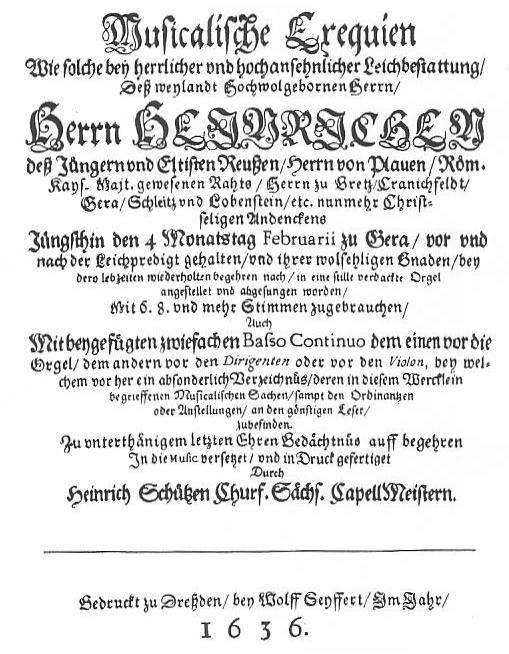
For the funeral of Count Heinrch Posthumous (yes, I'm not kidding) Reuss, Schütz composed a Lutheran type of funeral mass, the Musikalische Exequien, completely unique in form.
The Kreuzkirche in Dresden where Schütz worked.


The first movement is the Lutheran "missa brevis," the Kyrie and Gloria for six voices and/or instruments - Schutz and other of the time believed in an early sort of Gebrauchsmusik in which they could customize it depending on the forces available.  Only single parts of this score are extant, so there may have been any number of combinations in voicing or instruments.  Here, biblical texts showing the Christian's beliefs concerning death and resurrection are accentuated with chorale verses in a straightforward cantionale-homophonic texture.  As if to comfort the grieving listener, key concept in each verse are painted very obviously or repeated motivically.  For example, the Romans 14:8 mini-aria preceding the Kyrie II describes "living" and "dying" in Christ with appropriately perky or languid tempi.  "Our true life is in heaven," a duet sings, where the believer's likeness is transfigured unto Christ's, illustrated by a similar ornament transforming the word.  "The souls of the righteous are in God's hand" by the full ensembles is surrounded by the sopranos echoing "But they are at peace" (Ecclesiastes 3:1-3), wrapping the hearts of the faithful in rest.


Secondly, Psalm 73:25-26, the sermon text, becomes a double-choir motet.  The rich scoring does in no way obligate it to be overpowering, but instead it creates a quietly intense, prayerful tone.  "Whom have I in heaven but You? And there is none upon earth that I desire besides You. My flesh and my heart fail; but God is the strength of my heart and my portion forever."  Listen carefully.  Is there a familiar chorale melody hidden in there?  Hint:  it seems to be a common occurrence.  At the end, "my comfort" and "my part" scattered between the sides of the room provide a exclamation point, leaving the ear with "Jesus only."
Title page of the first print.


At last, the tenor intones the well-known Nunc Dimittis:  "Lord, now You let Your servant..." and the SATB choir finishes.  With written directions to be at a removed location from the main ensemble, two sopranos (Seraphim I and II) and a bass (the Departed Blessed Soul) sing "Blessed is the man who dies in the Lord" (Revelation 14:13) sailing ethereally over the congregation below.  The way in which Schütz arranges the two texts also seem to bring out other Scriptural comforts - the soloists' "They have rest after all their works, and their works follow them" is interrupted by the tutti "for all people," implying that the peace of the Church Triumphant lies in the same salvation believers grasp by faith on earth.  "Death" is the last word by the trio, while the choir finishes singing yet of God's glory.  

Enjoy!

Translation: http://www.spectrumsingers.org/archives/1997-98/mar98_words.html (This ensemble's notes are also helpful.)
Score:  http://imslp.org/wiki/Musikalische_Exequien,_Op.7_(Sch%C3%BCtz,_Heinrich)
Recording:  https://www.youtube.com/watch?v=_Gd1DqDUC2U

.

Sunday, July 20, 2014

Cheesecake girl.

How I often feel, living my single-girl musician graduate student life:  


Day 363:  the terror continues. Also, made another cheesecake! ...Very nearly.  Oh, and it’s my mum’s birthday. Happy birthday, Mum. I did make you a cheesecake, but it was too beautiful to live.


When one gets bored in her own little world, baking happens.  This gluten-free and vegan recipe happened quite well.

Chocolate Peanut-Butter "Cheesecake"

Crust:  
2 c. almond flour
1/4 c. unsweetened cocoa powder
1/4 c. coconut oil
2 tbsp. organic maple syrup
1 tsp. vanilla
Coffee as needed

Filling:
10 fresh figs, chopped
2/3 c. unsweetened cocoa powder
1 14-oz. package extra-firm tofu, drained
1/4 c. peanut butter
1/4 c. agave syrup
Dash of cinnamon

Blend all crust ingredients in food processor.  Press into 9-inch springform pan and chill in refrigerator.  Blend all filling ingredients until smooth.  Spread on top of crust and chill until firm.

Remember:  the cheesecake isn't the cheesecake - the cheesecake is the recipe!